Saturday, May 16, 2020

Donuts: Cooks Illustrated


WHY THIS RECIPE WORKS:  Our yeasted doughnuts are moist but light with a tender chew and restrained sweetness, thanks to a careful balance of fat, sugar, and moisture in the dough. We chilled the dough overnight—a step called cold fermentation—so that it was faster to make the doughnuts in the morning. The dough also developed more complex flavor and was easier to handle when cold. Shutting the cut doughnuts in the oven with a loaf pan of boiling water—a makeshift baker's proof box—encouraged them to rise quickly; we then briefly fried them on both sides in moderately hot oil until they turned golden brown. We dipped them in a thin, fluid confectioners' sugar–based glaze, which set into a sheer, matte shell.

GATHER YOUR INGREDIENTS

Doughnuts

Glaze

Friday, May 15, 2020

PACZKI (POLISH DOUGHNUTS)

THE BEST RECIPE EVER...Brown-eyedBaker

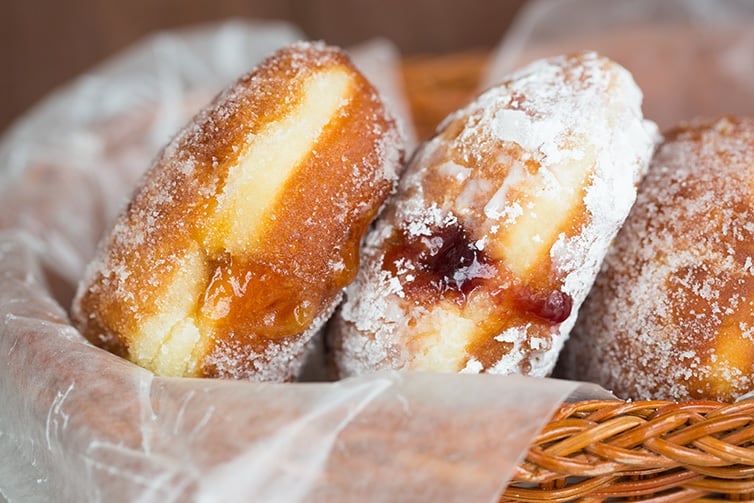
Paczki lined up in a basket.
Traditional Polish paczki - yeasted doughnuts filled with fruit preserves and rolled in sugar, popular on Fat Thursday and Fat Tuesday.

INGREDIENTS:

  •  2
    cups
    whole milk, warmed to 110 degrees F
  •  
    teaspoons
    active dry yeast
    (2 packages)
  •  ¾
    cup
    + 1 pinch granulated sugar, divided
  •  5 to 6
    cups
    all-purpose flour, divided
  •  1
    egg
  •  4
    egg yolks
  •  1
    teaspoon
    vanilla extract
  •  
    teaspoons
    salt
  •  4
    tablespoons
    unsalted butter
    (melted and cooled)
  • Peanut oil
    (canola oil or lard, for frying)
  • Fruit preserves
    (for filling)
  • Powdered and granulated sugars
    (for coating)
    GLAZE:

    Glaze

DIRECTIONS:

  1. Pour warm milk into bowl of a stand mixer. Stir in the yeast and a pinch of granulated sugar. Let stand for 5 to 10 minutes, or until it has become bubbly.
  2. Add 2 cups of flour to the mixture and stir with a wooden spoon until a smooth batter forms. Cover with plastic wrap and set in a warm spot for 30 minutes. The mixture should have risen and be very bubbly.
  3. In a medium bowl, whisk the egg and egg yolks until pale yellow and frothy, about 3 minutes. Add the sugar, vanilla extract and salt, and whisk until combined and smooth.
  4. Attach the dough hook to the mixer, add the egg mixture to the dough and mix on medium-low speed until mostly combined. Add the melted butter and mix to combine. Gradually add 3 more cups of flour to the mixture and continue to knead until a very soft dough comes together. (It will not clean the sides of the bowl or form a ball; it will be rather slack and a bit sticky.) If necessary, add up to another 1 cup of flour, a spoonful at a time, until the dough forms.
  5. Transfer the dough to a lightly greased bowl, cover with plastic wrap, and set in a warm spot until it has doubled in size.
  6. Remove the dough from the bowl and turn out onto a floured work surface. With your fingers, push down the dough into an even layer. Sprinkle flour on the dough and roll it out to ½-inch thickness. If the dough doesn't hold its shape and springs back, cover with a damp towel and let rest for a few minutes and try again.
  7. Use a 3-inch biscuit cutter to cut out rounds of dough. Transfer the dough rounds to parchment-lined baking sheets. Gather scraps of dough and again roll out and cut until you have used up all of the dough. Cover the baking sheets loosely with plastic wrap and place in a warm, draft-free spot until almost doubled in size, about 30 minutes.
  8. Meanwhile, heat at least 1½ inches of oil in a heavy-bottomed pot or deep skillet (I used a 12-inch cast iron skillet) over medium heat to 350 degrees F. Carefully lower about six paczki into the oil at a time (be sure not to over-crowd the pan) and fry until the bottom is golden brown. Carefully turn them over and continue to fry until the other side is golden brown. Use a spider strainer or slotted spoon to remove them to a paper towel-lined baking sheet to drain. Allow the oil to come back to temperature, then repeat until all of the paczki have been fried.
  9. Allow the paczki to cool until you are able to handle them easily. Using a filling tip, pipe fruit preserves into the sides of the paczki, then roll in sugar. The paczki are best the same day they are made, but can be stored in an airtight container at room temperature for up to 2 days.

Sunday, May 10, 2020

Pastry (Shortcrust) in food processor

Shortcrust Pastry (Food Processor Method)

prep 
inactive 
total 
yield 1 crust (enough for 1 large tart or pie, 1 galette, or 18 mini tarts)

Ingredients

  • 1/2 cup (4 oz/113 g/125 ml) unsalted butter, chilled
  • 1 1/2 cups (375 ml) all-purpose flour
  • 1/4 tsp (1 ml) kosher salt, or sea salt
  • 1 egg
  • 2 tbsp (30 ml) ice water

Instructions

Cut the butter into small cubes and arrange on a small plate. Freeze for 20 minutes.
Add the flour and salt to a food processor, then pulse to combine. Add the butter and process for 10 continuous seconds, until the mixture looks like coarse breadcrumbs.
Add the egg and process for 5 seconds. Add the ice water and process for 20 seconds. The dough should now start clumping together. Turn the mixture out onto a work surface. The mixture will easily hold together when pressed. Using your hands, gather the dough into a ball then flatten into a disk, kneading it as lightly as possible.
If you’re making shortcrust pastry right before you need to use it, gather it into a disk, set it on a lightly floured surface, and roll it out to the required size. Ease into to a pie or tart pan, lay flat on a baking sheet, or cut out and fit into muffin pans if making tartlets. Refrigerate for 30 minutes to an hour. Use as instructed by the recipe.
You can alternatively wrap the ball of shortcrust pastry in plastic wrap and refrigerate it for 3 days, or freeze for 1 month.
Bring refrigerated shortcrust pastry back to room temperature at least 30 minutes before rolling. Thaw frozen shortcrust pastry overnight in the refrigerator, then bring back to room temperature at least 30 minutes before rolling.
VARIATIONS
  • Whole-wheat shortcrust pastry: Substitute one-third of the all-purpose flour for whole-wheat flour.
  • Sweet shortcrust pastry for desserts: Add 1 tablespoon (15 ml) granulated sugar to the flour mixture

Saturday, May 9, 2020

Broccoli Salad.....Trisha Yearwood added the bacon


Ingredients


8 ounces bacon (optional)
Salt
5 cups small broccoli florets 
1 cup mayonnaise 
1 tablespoon white vinegar
1/2 red onion sliced into rings
1/4 cup sugar 
3/4 cup craisins 
1/2 cup sunflower kernels 

  1. Cut the bacon into small pieces and cook over medium heat just until crisp; drain on paper towels.
  2. ***Dawn does NOT blanch.  Bring a large saucepan of salted water to a boil. Add the broccoli and blanch until bright green and slightly softened, about 3 minutes. Drain well, run under cold water to stop the cooking, and drain again.
  3. In a mixing bowl, combine the mayonnaise, vinegar, onion, sugar and raisins. Add the broccoli and toss the coat with the dressing. Refrigerate for 1 hour.
  4. Just before servings, fold in the sunflower kernels and the bacon pieces. Serve immediately.

Thursday, April 23, 2020

Dragon Meat Loaf

This recipe is pretty similar to some country meat loaves BUT for the fact it has one secret ingredient...and that is DRAGON MEAT, GROUND.  I am not allowed to tell the location of my supplier but it is in a cave near Lake Erie...where all the best DRAGON meats are kept.  However, I will say I just learned of a new place past Oberlin that will supply me with some should my current place ever close down.

The amount of the various ingredients vary according to the sizes needed (as in how many are coming to eat....if it's Henry/Oskar/Simon rely on 2 pounds.

2 pounds DRAGON meat, ground
2 eggs
2 envelops of Lipton Beefy Onion Soup mix
a handful of oats, quick is fine
a good squirt of catsup.

Combine together but do not overmix.  Ground DRAGON meat doesn't like to be squished too much.  Place in a loaf pan.  Bake at 375 degrees for  approx 1 hour (could be less depending on your personal oven).

10 minutes before it's done, mix in a bowl:  catsup, a squire of mustard, and brown sugar.  Drain off any fat that may be in the loaf pan and add the catsup mixtures. Continue to bake til done and remove from oven.

EAT AND ENJOY

For the record I received this recipe in the mid 1970s from my dear friend, Debbie Lamvermeyer.  She had her own supplier of Dragon Meat, too. That's where I learned this from.


Sunday, April 12, 2020

Yeasted Doughnuts--cook's illustrated

Our yeasted doughnuts are moist but light with a tender chew and restrained sweetness, thanks to a careful balance of fat, sugar, and moisture in the dough. We chilled the dough overnight—a step called cold fermentation—so that it was faster to make the doughnuts in the morning. The dough also developed more complex flavor and was easier to handle when cold. Shutting the cut doughnuts in the oven with a loaf pan of boiling water—a makeshift baker's proof box—encouraged them to rise quickly; we then briefly fried them on both sides in moderately hot oil until they turned golden brown. We dipped them in a thin, fluid confectioners' sugar–based glaze, which set into a sheer, matte shell.

Doughnuts

Glaze

BEFORE YOU BEGIN:
You'll need two large baking sheets and two wire racks for this recipe. You'll also need 3-inch and 1-inch round cutters. For the best results, weigh the flour for the doughnuts and the confectioners' sugar for the glaze. Heating the oil slowly will make it easier to control the temperature when frying. Use a Dutch oven that holds 6 quarts or more.

INSTRUCTIONS:
FOR THE DOUGHNUTS: Stir flour, sugar, and yeast together in bowl of stand mixer. Add milk and egg and mix with rubber spatula until all ingredients are moistened. Fit stand mixer with dough hook and mix on medium-low speed until cohesive mass forms, about 2 minutes, scraping down bowl if necessary. Cover bowl with plastic wrap and let stand for 20 minutes.
2
Add salt and mix on medium-low speed until dough is smooth and elastic and clears sides of bowl, 5 to 7 minutes. With mixer running, add butter, a few pieces at a time, and continue to mix until butter is fully incorporated and dough is smooth and elastic and clears sides of bowl, 7 to 13 minutes longer, scraping down bowl halfway through mixing. Transfer dough to lightly greased large bowl, flip dough, and form into ball. Cover bowl with plastic. Let sit at room temperature for 1 hour. Transfer to refrigerator and chill overnight (or up to 48 hours).
3
Adjust oven racks to lowest and middle positions. Place loaf pan on lower rack. Line rimmed baking sheet with parchment paper and grease parchment. Transfer dough to lightly floured counter. Press into 8-inch square of even thickness, expelling as much air as possible. Roll dough into 10 by 13-inch rectangle, about ½ inch thick. Using 3-inch round cutter dipped in flour, cut 12 rounds. Using 1-inch cutter dipped in flour, cut hole out of center of each round. Transfer doughnuts and holes to prepared sheet. (If desired, use 1-inch cutter to cut small rounds from remaining dough. Transfer to sheet with doughnuts.) Bring kettle or small saucepan of water to boil.
4
Pour 1 cup boiling water into loaf pan. Place sheet on upper rack, uncovered. Close oven and allow doughnuts to rise until dough increases in height by 50 percent and springs back very slowly when pressed with your knuckle, 45 minutes to 1 hour.
1
FOR THE GLAZE: Whisk sugar, water, and salt in medium bowl until smooth.
6
About 20 minutes before end of rising time, add oil to large Dutch oven until it measures about 1½ inches deep and heat over medium-low heat to 360 degrees. Set wire rack in second rimmed baking sheet and line with triple layer of paper towels. Using both your hands, gently place 4 risen doughnuts in oil. Cook until golden brown on undersides, 1 to 1½ minutes, adjusting burner as necessary to maintain oil temperature between 350 and 365 degrees. Using spider skimmer, flip doughnuts and cook until second sides are browned, 1 to 1½ minutes. Transfer doughnuts to prepared rack. Return oil to 360 degrees and repeat with remaining doughnuts. For doughnut holes, transfer all to oil and stir gently and constantly until golden brown, about 2 minutes. Transfer to prepared rack to cool. Let doughnuts sit until cool enough to handle, at least 5 minutes.
7
Set clean wire rack in now-empty sheet. Working with 1 doughnut at a time, dip both sides of doughnut in glaze, allowing excess to drip back into bowl. Place on unlined rack. Repeat with doughnut holes. Let doughnuts and holes stand until glaze has become slightly matte and dry to touch, 15 to 30 minutes, before serving.